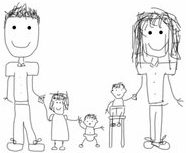

Friendship in parenthood often feels like a tender seed you hope will grow—playdates carefully arranged, laughter shared in muddy parks, and the promise of something lasting for both children and adults. But sometimes, those seeds never sprout. Even the friendships that start brightly can fade into silence without explanation, leaving children with unanswered questions and parents quietly grieving connections that never quite became what they hoped. This poem, The Waiting Game, was born from that ache—the longing for friendships that stayed, and the gentle work of helping children understand when they don’t.
When Friendships Mean Even More
For me, making friends as a parent has always carried extra weight. Years ago, trauma meant moving countries and leaving the genuine friends who still fill my heart, no matter the distance. I cherish all they were to me, and some days, that loss aches more sharply than I expect. As someone with no close family network—my father dead, the rest scattered across miles, and my mother and sister absent by choice—friendship became my anchor, my community, my support. Yet even as I tried to build that safety net here, I’ve realised that longing has a cost.
Now, I’m learning to accept that regular weekly meetings after swimming lessons or playgroups are more than enough for my children, and therefore must be enough for me, too. Their world is rich, even if our circle is small. This lonely heart, I’ve decided, is mine to hold—not for my kids to carry.
Poem: The Waiting Game
I set the table for friendship,
lay it out with guinea pig giggles,
parks and puddles,
the wide‑eyed joy of children
who still believe tomorrow
will always bring the same faces back.
But the doorbell does not ring.
The silence stretches,
folding weeks into months.
Promises scatter like feathers,
light words lifted into a sky
where no one explains
why they don’t come back down.
You said “soon” —
but soon became stone,
a mountain of nothing between us.
My children still carry
the echo of laughter,
pebbles in their pockets
from the one good day
they thought might become forever.
And I am left apologising to them
for choices I didn’t make,
for adults who vanish,
for hearts that were wide open
and met with half‑closed hands.
Was it me? Was it us?
Was it something sacred,
something secular,
or simply convenience
that weighed heavier than love?
I delete the app,
delete the ache of staring
at unblinking screens.
Yet still I wait,
grieving friendships
that were never given a chance
to stand on their own two feet.
And though I gather my courage
to seek other paths,
tonight I sit with the hurt—
a mother who only ever wanted
to see her children running free
with friends who stayed.
Years may roll forward,
and perhaps my children
will not even ask again
for the names that once filled our days.
But in quiet moments —
birthdays, conversations,
scraps of memory —
those faces resurface.
“They are my friend,” they’ll say,
and I’ll nod,
holding the truth gently in my mouth:
that friendship sometimes flickers
on another parent’s whim,
that we were never told why
our laughter wasn’t enough
to secure tomorrow.
How do I explain
that I had no answer,
that sometimes people drift
not because we failed,
but because they counted differently,
measured time in smaller cups,
kept their doors only half‑unlatched?
I watch my children together —
siblings bound by mud, by giggles,
by a shared language of outrageous joy.
Their spark alone
is a universe of love,
a reminder that friendship need not be asked for
when family already dances in rhythm.
And yet, still,
I mourn the friendships
never allowed to grow tall.
For in the brief hours
when other children joined our chaos,
something beautiful glimmered:
a widening, a bright chorus,
a taste of the world beyond these walls.
It is strange indeed —
strange and baffling —
that others chose distance
when laughter was offered freely,
when kindness lived in our muddy joy.
But I cannot untangle
the quiet knots in another heart.
I can only keep extending my open hand,
knowing our worth,
knowing our flame.
And if one day,
grown children wonder aloud
why there weren’t more
playmates tumbling through our days,
I’ll tell them honestly:
“We were ready,
we were open,
we were good friends to have.
Sometimes, that readiness
was not returned.
But never doubt
that you were enough —
bright enough, wild enough, kind enough.
Always enough.”
 Gentle Parent