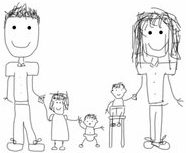
What does “falling behind” actually look like in a child? We are now unschooling a nine-year-old and seven-year-old twins. As part of our parenting journey, we’ve grown to understand the importance of nurturing their intrinsic motivation rather than relying on praise or extrinsic rewards. Our aim is to keep their own sparks alive and avoid interfering with their internal belief systems.
Embracing “Unproductive” Learning
Looking back over these first none years, it often felt like an unrelenting journey through what might be called “unproductive” learning. Yet, amidst this, there have been moments of undeniable insight. The majority of their learning has been driven by curiosity, not curriculum. For example, both girls learned to read fluently purely driven by their own desire to understand the world around them—without formal instructions or phonics drills. Besides that, the only glimpses of what might resemble peer-schooled performance have appeared sporadically.
Math Without Mastery Pressure
For instance, can my kids confidently sit and do basic arithmetic? Maybe… maybe not. Our nine-year-old can work out simple addition, and they all can figure out differences—essentially subtraction—if it’s relevant to something they’re engaged with. But multiplication? If it’s small enough that they can treat it like long addition. Division? I’m not even sure they know the word.
There’s a moment from yesterday I can’t stop thinking about. My 9-year-old asked if five months equals 150 days. Instead of reaching for a rule or asking me for the answer, she drew five groups of three lines—almost like tally marks—and began adding in tens until she reached 150.
What struck me wasn’t just that she got the right answer. It was how she got there.
With almost no formal instruction—just the occasional conversation about adding in tens—she reconstructed the logic behind 5 × 30 = 150 in her own way. She grouped, counted, adjusted, and persisted until it made sense. No memorised formula, no worksheet—just genuine problem-solving.
I know this might sound unsettling if you’re used to the idea that maths needs to be taught early and explicitly. But what I saw in that moment felt far more significant than correct recall. She wasn’t repeating maths—she was building it.
What she’s beginning to grasp is the structure underneath the numbers: grouping, patterns, relationships. These are the roots of multiplication, not as something to memorise, but as something to understand.
And that’s the part that feels worth holding onto—especially in the middle of the messy, chaotic, play-filled days. Because beneath that apparent chaos, something deeply coherent is forming.
Moments of Ingenuity
Looking back to my own childhood, I recall how my teacher had told us we were going to be making maps, tea-staining them, and burning holes in them—an activity I was proud of completing, mostly with the help of others. My oldest daughter, at about the same age, created her own map—detailing everything herself—and then, quite spontaneously, turned it into a spy-glass. Zero input from me or anyone else, just an idea from her own curiosity and desire. That was a moment of genuine ingenuity—an act of creation from within, driven solely by her own desires. It’s a kind of learning that many adults still struggle to do, yet she was only six years old.
Natural Reading Milestones
Our youngest daughter had an innate drive from a young age to learn to read. Toward the end of her third year, she was already reading, and by the end of her fourth year, she was reading chapter books independently. Her older sister looked on in awe, asking, “How did she learn to read?” When I explained how she had learned, my oldest daughter then took off in her little sister’s footsteps, and within a short period, they were both reading fluently.
It’s worth noting that our oldest was six when she asked how her sister had learnt to read. If she had been tested against her peers in the school system, even a couple of months before she started mastering it, she might have been considered a failure. Now she reads with ease. No phonics drills, no enforced read-alouds. There’s no need to force reading, when the kids want their parents to read to them, for the joy of the stories and the closeness of their loving parent. No external pressure—just their natural drive and curiosity guiding their learning.
Celebrating Creative Writing
Our oldest daughter has just turned 9-years-old, and our youngest daughter has turned 7-years-old recently. They both love to draw and now write. They ask all day long how to spell things, and I’m sure I’ve repeated those spellings many-a-time. They have both mastered some words if it’s characters they love, or family’s names, and some other common words.
But again, if tested against her schooled peers, how would my 9-year-old fare? Yet, she loves to draw and write. I’m focusing on not judging or correcting mistakes so she continues trying. I swell with emotions when I see yet another misspelled word marking a picture she’s drawn. It’s not the accuracy of the spelling that I hope for but the drive to communicate and to give it a try, regardless of outcome. No fear of failure, just the confidence to give something unknown a best attempt and continue learning from that point on.
True Markers of Progress
These stories highlight something invaluable: the incredible potential children have when guided by intrinsic motivation rather than external benchmarks. Their ability to innovate, create, and learn deeply is often shut down or overlooked in traditional schooling. Instead of focusing solely on assessments and grades, I see these spontaneous moments of ingenuity and love for learning as true markers of progress—markers that no tested or curriculum-based measure can truly capture.
I’d love to know—what do you see as real progress in your child? And have you ever noticed a moment where they figured something out in their own unexpected way?


This is a lovely post, you are so right. I was home educated, and I think it is wonderful. It sounds like the learning is happening very naturally with you. ❤
LikeLike
Thank you so much, that really means a lot! It’s lovely to hear from someone who was home educated 😊
LikeLiked by 1 person
😀 You’re very welcome! It’s wonderful to hear all about your experiences. xxx
LikeLike
We were mostly homeschooled and hated it (we were homeschooled as we changed countries and continents quite often). We believe it is extremely important for children to learn to stand their ground and cope with the pressure to perform. If one wants their children to make a special carrier it’s much better too have them attended a ‘normal school’.
The Fab Four of Cley
🙂 🙂 🙂 🙂
LikeLiked by 2 people
Sorry to hear homeschooling wasn’t a positive experience for you—that sounds like it must have been challenging, especially with so much moving around. I think experiences can vary a lot depending on circumstances, just like they do with traditional schooling. Some thrive in one environment and others in another. I appreciate you sharing your perspective—it’s an important consideration for parents to make.
LikeLiked by 1 person
i don’t think homeschooling or unschooling is supposed to be a positive experience all the time. nothing is. it’s just an experience, that allows you to be yourself in a world that doesn’t want you to be yourself. it’s inherently difficult. but in the end, you are a different breed from all the others. that is priceless.
LikeLike
maybe not the homeschooling but the moving around and instability of not having a homebase, that you hated? just spitballing here.
LikeLike