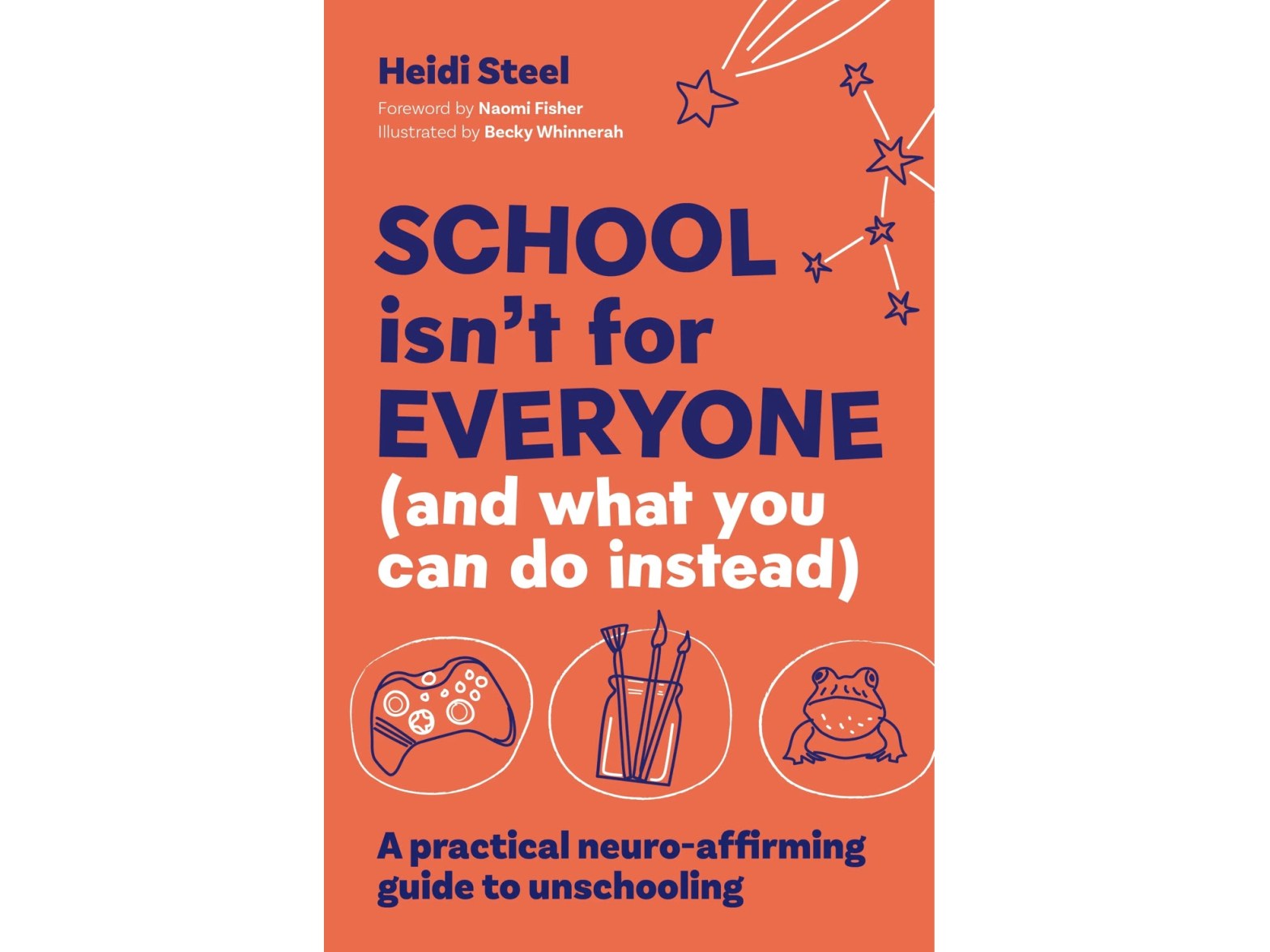
When I picked up School Isn’t For Everyone by Heidi Steel, I expected an encouraging and thought-provoking read about unschooling and home education — especially knowing that Naomi Fisher had written the foreword. What I didn’t expect was just how deeply parts of the book would resonate with me, particularly its compassionate approach to children, neurodiversity, play, and self-directed learning. At the same time, certain discussions around gaming and screens challenged me in ways I hadn’t anticipated. This book left me reflecting not only on education, but also on modern childhood, trust, boundaries, and what it truly means to raise children outside the norm.
My interest in the book was already high before I even began reading it. I had read one of Naomi Fisher’s earlier books a couple of years ago, and knowing that she and Heidi Steel had connected through their own unschooling journeys made me even more curious to explore Heidi’s perspective in full.
What Makes This Unschooling Book Unique and Helpful
Throughout the book, Heidi Steel includes practical exercises and reflective prompts designed to help parents work out their own approach to unschooling and better understand what may benefit their children most. These activities feel valuable not only for parents who are new to unschooling, but also for those already well into the journey and looking to reassess or deepen their approach.
The book also weaves in stories from many other unschooling families, offering a wider range of perspectives rather than presenting only the author’s personal experience. This diversity makes the book feel grounded and reassuring, particularly for readers who may still be questioning whether unschooling could work for their own family.
When School Is A Problem
Before reading this book, I had never really considered how small the home education community is in the UK. Approximately 1% of children are home educated, and only a fraction of those families would identify as fully unschooling. It is, undeniably, an unusual path.
That idea made me reflect on other uncommon experiences in my own life. I have type 1 diabetes, which affects around 0.1% of the population. I also had three babies under the age of two — another statistical rarity — and later experienced triandem breastfeeding, something I only discovered was even possible thanks to a stranger who mentioned she was doing the same when I was pregnant with twins and caring for a one-year-old. I’ve also breastfed children into early childhood, which remains relatively uncommon in the UK.
Reading this chapter made me wonder whether many unschooling parents have other experiences of choosing unconventional paths, despite social norms or expectations. Perhaps following one unusual path gives you the confidence to trust yourself enough to follow another. I would genuinely love to hear whether other unschooling families feel the same.
This chapter also includes perspectives from a teacher with 14 years of experience in primary education. I found this particularly interesting. I imagine many teachers would read these reflections with knowing nods, while for non-teachers like myself it offered valuable insight into the realities of the school system and further reinforced many of the reasons we feel drawn towards unschooling.
Neurodiversity
A significant part of the book discusses neurodivergent children and the ways many struggle within traditional school systems before later moving into homeschooling, home education or unschooling.
The case studies involving autistic children, in particular, may resonate deeply with families currently questioning whether school is the right environment for their child. The book gives language to many of the struggles children experience in school settings, helping parents feel understood rather than isolated.
Heidi Steel also includes thoughtful questions and prompts to help parents better understand their children’s unique needs and identify ways to create a calmer, more sustainable family life that focuses on what truly matters.
The First Year Without School
One aspect I would have loved to read more about was the author’s experience of raising children who had never attended school at all. Although several chapters discuss the transition period after removing a child from school — and what families might expect during deschooling — the author’s own children never attended school, so I found myself curious about how unschooling unfolded naturally from the very beginning in her household.
Not Being The Teacher
One of the most refreshing themes throughout the book is the idea that home educating does not mean replicating school at home.
Heidi Steel encourages readers to reflect on their own experiences as students — or as teachers, where relevant — and offers alternative ways of supporting children’s learning without positioning parents as traditional teachers. This perspective feels both freeing and reassuring.
Whether you are an experienced unschooler, just beginning your home education journey, or simply exploring whether this lifestyle could work for your family, this section offers thoughtful and encouraging insight.
Child’s Play
Chapter 7 of School Isn’t For Everyone delves into play and learning through play. Heidi Steel distinguishes between child-led play and play-based learning, and I found her perspective on the difference both reassuring and informative.
It was also strangely comforting to read in black and white that “unschooling mess” is a real thing — often a frustrating mental burden for caregivers, yet also an essential part of genuine, creative play. Heidi also includes a useful reference table comparing play from early childhood through to adolescence.
What Do Families Need To Unschool?
The book poses the question: What is the one thing you need in order to unschool? Heidi Steel explores several answers commonly given by unschooling parents before arriving at her own conclusion — one that becomes a recurring theme throughout the book and, I suspect, throughout many home-educating families’ journeys.
I won’t spoil it for those yet to read the book.
Unschoolers Learning to Read
The book explores the contrast between school-based approaches to reading and child-led literacy development within unschooling. The author discusses how formal instruction can sometimes create resistance, anxiety, or disengagement around reading, and argues instead for trusting children to develop literacy naturally through everyday life, interests, and immersion in language.
One aspect I found more difficult personally was the emphasis on gaming as a route into literacy. Heidi mentions that her children’s first confidently read words included “pause”, “play”, “zombie”, and “Minecraft”, and she shares examples of other unschooled children learning to read through gaming environments.
While I appreciate that many families genuinely do experience literacy growth through games and digital media, I found myself uncomfortable with how central screens appeared within some of the examples.
Partly, this is because home education and unschooling are often stereotyped by outsiders as being heavily screen-based or lacking structure, and I am conscious that these examples may reinforce that perception for some readers. Our own approach at home is relatively screen-light, so my perspective naturally differs here. My children spend only limited time using screens, and most of their literacy experiences come through conversation, books, storytelling, writing, and everyday life.
That said, the wider message of the book is not really about gaming itself, but about trust: trusting that children can and do learn to read in different ways, at different ages, and through different interests. Even where I didn’t personally relate to every example, the discussion around pressure-free learning and preserving a child’s enjoyment of reading resonated with me.
Unschoolers & Screens
During the second half of the book — particularly within the reading section discussed above — there are several discussions around children and screens. I suspect that families who fully embrace screens within their home education approach will find this aspect of the book especially affirming.
For me, this was the main area of disagreement.
Naomi Fisher’s Changing Our Minds gave me a similar feeling. Like Heidi Steel’s work, I occasionally felt there was a bias towards viewing screens and gaming positively. Perhaps this reflects the circles many unschooling families move within, or the fact that gaming has become such a common part of modern childhood.
One passage in particular stood out to me on page 234:
“All these moments, the endless cake baking, the spillages, the sibling fights, the (hundreds of) hours of Minecraft… how you respond to them, support them and love them through it all…”
It is, in many ways, a beautiful summary of a home-educating parent’s role: to remain a child’s steady source of support through all aspects of life.
At the same time, I could not ignore my own reaction to the phrase “hundreds of hours of Minecraft.” Personally, I cannot help but feel that if a child spends hundreds of hours immersed in one game, that is also hundreds of hours not spent moving their bodies, creating from their own imagination, exploring outdoors, or engaging in free play away from external stimulation.
Of course, this is deeply personal, and one of the strengths of unschooling is that families can shape their own values and rhythms.
I also think conversations around screens deserve nuance and caution, particularly when books may be read by families who are very new to unschooling. Some children can engage with screens casually and move away from them easily, while others find them far more regulating, immersive, or difficult to step back from. Developmental maturity, temperament, and individual needs all matter.
For our family, I still feel comfortable holding boundaries around gaming, mobile phones, and television, while also recognising that screens can absolutely have a meaningful place in children’s lives. We enjoy documentaries, occasional family films, researching questions together online, and creative projects that involve technology. My concerns are less about screens existing at all, and more about balance, overstimulation, online safety, and protecting space for offline childhood experiences.
One quote from a parent in the book mentioned their son playing Minecraft “with random people we don’t know,” and although the context may have been completely safe and supervised, it reminded me that online spaces do carry genuine risks. Children can encounter harmful content, unhealthy social dynamics, or unsafe individuals online, and I personally feel these realities deserve careful consideration alongside the benefits often discussed.
Towards the end of the book, Heidi Steel encourages families to think of screens as tools — not entirely different from art supplies or equipment for hobbies. I understand the intention behind this comparison, and I appreciate the broader message of reducing fear and control around learning. Even so, I think many parents will still want to approach screens thoughtfully and with age-appropriate boundaries in place.
Conclusion
Ultimately, although I strongly disagreed with some aspects of the book’s perspective on gaming and screens, I still found School Isn’t For Everyone thoughtful, compassionate, and deeply encouraging overall. It raises important questions about education, trust, childhood, and family life, and I imagine many parents exploring home education or unschooling will find comfort and reassurance within its pages.

